


Is Your Understanding of iPhone Costs Broken? Let’s Fix It!
Have you ever looked at your shiny new iPhone, with its thousand-dollar price tag, and thought, “I bet this only costs them a few bucks to make!”? It’s a common thought, often fueled by rumors that pop up online every year. You might have even heard someone ask, how much does it cost to make an iPhone? and get a wild answer like ten dollars.
If you’ve ever been confused by the huge gap between the rumored cost and the price you pay at the store, you’re in the right place. Think of this guide as a repair kit for your understanding. The “problem” isn’t with your phone; it’s with the myths surrounding its cost.
We’re going to fix that confusion for you. In five clear and simple steps, we’ll walk you through exactly what goes into the cost of an iPhone, from the tiniest screw to the massive global marketing campaigns. Let’s get started!
Step 1: Unpacking the Bill of Materials (BOM)
First things first, let’s discuss the physical components. In the manufacturing world, the list of all the raw components needed to build a product is called the Bill of Materials, or BOM for short. Think of it as a grocery list for making an iPhone.
Every single component, from the beautiful OLED screen to the powerful A-series processor and the advanced camera system, is included on this list.
The Most Expensive Parts in Your iPhone
Not all parts are created equal. Some components cost way more than others. Typically, the three most expensive parts of any iPhone are:
- The Display: Apple uses stunning, high-resolution OLED screens, often sourced from companies like Samsung and LG. This is usually one of the priciest components.
- The Processor: The “brains” of the operation, the A-series Bionic chip (like the A17 Pro), is custom-designed by Apple. This powerful, tiny chip is a marvel of engineering and carries a high cost.
- The Camera System: The advanced multi-lens camera systems, with their sophisticated sensors and lenses, are also a significant part of the total cost.
So, how much does it cost to manufacture an iPhone when you just add up the parts? Tech analysts at firms like Nikkei Asia and Counterpoint Research perform detailed “teardowns” of new iPhones to estimate the BOM.
Here’s a look at the estimated BOM for some recent iPhone models:
| iPhone Model | Estimated Bill of Materials (BOM) | Launch Retail Price (Base) |
| iPhone 15 Pro Max | ~$558 | $1,199 |
| iPhone 14 Pro Max | ~$501 | $1,099 |
| iPhone 13 Pro | ~$548 | $999 |
| iPhone 12 | ~$373 | $799 |
Source: Data compiled from reports by Nikkei Asia and Counterpoint Research.
As you can see, the cost of just the parts for an iPhone 15 Pro Max is over $550. That’s already a long way from the $10 myth!
For complete technical specifications and official pricing, visit Apple’s official iPhone specifications and pricing page
Step 2: Adding Assembly and Manufacturing Costs
Having a pile of expensive parts is great, but someone has to assemble them all. This is where manufacturing and assembly costs come in.
Apple partners with major assembly companies, most notably Foxconn, to manufacture millions of iPhones. This process involves:
- Labor: The wages for the hundreds of thousands of workers on the assembly lines.
- Factory Overhead: The cost of running the huge factories, including electricity, maintenance, and machinery.
- Quality Control: Testing each device to make sure it works perfectly before it gets shipped out.
While this assembly cost is smaller than the BOM, it’s still a crucial part of the total manufacturing expense. It’s the step that turns a box of components into the sleek device you hold in your hand.
Step 3: Factoring in the ‘Invisible’ Costs
This is the step that most people forget, and it’s the biggest reason why the final price is so much higher than the parts cost. The Bill of Materials only accounts for the physical hardware. It doesn’t include the enormous investments Apple makes long before a single iPhone is even built.
Research & Development (R&D)
Apple spends billions of dollars every single year designing the next iPhone. This includes:
- Designing the custom A-series and M-series chips.
- Developing new camera technologies.
- Engineering the hardware to be durable and water-resistant.
- Creating and testing new features.
This massive R&D budget is spread across all the products Apple sells.
Expert Insight: In a 2023 financial report, Apple revealed it spent over $22 billion on R&D in just nine months. This massive investment is a key part of the iPhone’s cost.
Software and Ecosystem
Your iPhone runs on iOS, a powerful and secure operating system. The cost to develop, update, and maintain iOS is immense. This includes fixing bugs and adding helpful features, like making it easier to figure out how to see unsent messages on iphone. It also covers the costs of running the App Store, iCloud, iMessage, and other services that make the iPhone experience what it is. All those amazing features, from Face ID to the ability to how to screen record on iphone, are backed by this massive software investment.
Marketing, Sales, and Distribution
Have you seen those beautiful iPhone commercials? Or visited a stunning Apple Store? That all costs money.
- Marketing: Global advertising campaigns, launch events, and product reviews.
- Sales: The cost of running Apple Stores, paying retail employees, and managing carrier partnerships.
- Logistics: Shipping millions of iPhones from factories in Asia to every corner of the world is a complex and expensive operation.
- Packaging: The iconic iPhone box is also part of the cost.
All of these “invisible” costs add up significantly and are a major piece of the puzzle in determining how much does it cost to make an iPhone.
According to MIT Technology Review’s analysis on manufacturing costs, the true expense extends far beyond components
Step 4: Understanding Apple’s Profit Margin
Now we get to the big question: How much profit does Apple make per iPhone? It’s not as simple as subtracting the parts cost from the retail price.
Let’s use the iPhone 15 Pro Max as an example.
- Retail Price: $1,199
- Estimated Parts Cost (BOM): $558
The difference is $641. This is called the gross margin. But that $641 isn’t pure profit! Apple has to use that money to pay for all the “invisible” costs we just talked about in Step 3: R&D, marketing, software development, shipping, employee salaries, and more.
After all those expenses are paid, what’s left is the net profit. While Apple doesn’t release profit figures for each specific product, its overall corporate profit margins give us a good idea. The company is very profitable, but it’s because they operate at an enormous scale, not because they build phones for pennies.
Step 5: Putting It All Together – A Real-World Breakdown
Let’s “fix” your understanding once and for all with a clear, step-by-step view of an iPhone’s true cost.
How to Understand the Real iPhone Cost in 5 Steps:
- Start with the Parts (Bill of Materials): The physical components for a high-end model like the iPhone 15 Pro Max cost around $558. This includes the expensive screen, processor, and cameras.
- Add Assembly Costs: Factor in the labor and factory costs from partners like Foxconn to assemble all those parts into a working phone.
- Include ‘Invisible’ Overhead: Add a portion of Apple’s billions in annual spending on Research & Development (designing the phone and chips), marketing (commercials and stores), and software (iOS updates).
- Consider the Gross Margin: The retail price ($1,199) minus the manufacturing cost gives you the gross margin. This is the pool of money used to pay for all the ‘invisible’ overhead.
- Deduct Overhead for True Profit: After all the costs from Step 3 are paid from the gross margin, the leftover amount is Apple’s net profit on the device.
This five-step view shows that building, designing, and selling an iPhone is a far more expensive process than just adding up the parts.
So, Does It Really Cost $10 to Make an iPhone?
Let’s put this myth to bed for good. No, it absolutely does not cost $10 to make an iPhone.
This is one of the most persistent tech myths out there. The claim does it really cost 10 to make an iPhone is completely false. As we’ve seen, the cost of raw materials alone for a modern iPhone is over 50 times that amount.
The myth likely survives because people dramatically underestimate the “invisible” costs of R&D, software, and marketing that are essential to creating and selling a product like the iPhone.
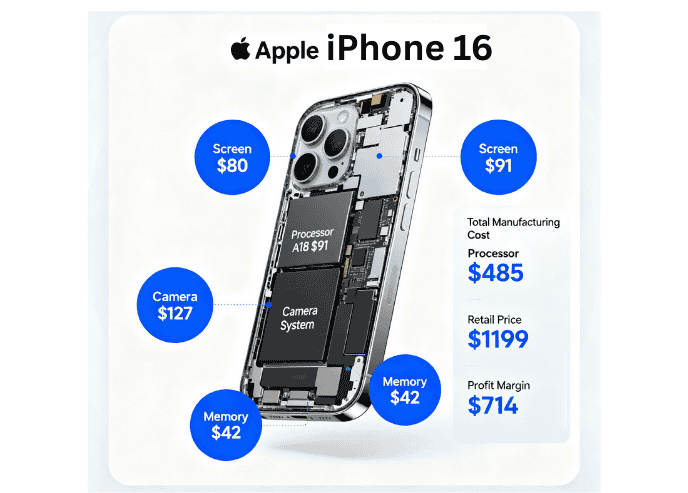
What About Future iPhones Like the iPhone 16?
As you read this, Apple is already hard at work on the next generation of iPhones. So, how much does it cost to manufacture an iPhone 16?
While we won’t know for sure until it’s released and torn down by analysts, we can make some educated guesses. The cost to manufacture iPhones tends to creep up over time. New technologies like more advanced AI chips, brighter and more efficient displays, and even more powerful cameras all add to the Bill of Materials.
For a potential device like the how much does it cost to make an iPhone 16 Pro Max, we can expect the BOM to be even higher than the iPhone 15 Pro Max’s $558. While Apple gets better at manufacturing at scale, the push for innovation almost always means using newer, more expensive components.
Understanding these costs can help you make informed decisions, especially if you’re buying a used phone and want to know how to see if iphone is unlocked for use with a different carrier.
Frequently Asked Questions (FAQs)
Q1: How much does it cost to manufacture an iPhone 15?
The estimated cost for just the parts (Bill of Materials) for the iPhone 15 Pro Max is approximately $558. This does not include assembly, R&D, marketing, or software costs, which add significantly to the overall expense for Apple.
Q2: How much profit does Apple make per iPhone?
Apple does not disclose the exact profit for each iPhone sold. The gross margin (retail price minus manufacturing cost) is high, but this amount must cover all of Apple’s massive operating expenses, including R&D, marketing, and software development, before a final net profit is realized.
Q3: Why is the iPhone so expensive if the parts aren’t that costly?
The price of an iPhone covers much more than just the parts. A huge portion of the cost goes toward “invisible” expenses like research and development (designing the hardware and software), global marketing campaigns, logistics, and the development of iOS and the App Store ecosystem.
Q4: Does it really cost only $10 to make an iPhone?
This is a persistent myth and is completely false. The raw components for a modern iPhone cost over $500, which is more than 50 times the mythical $10 figure.
Q5: Which part of the iPhone is the most expensive?
Typically, the most expensive components in an iPhone are the custom-designed processor (e.g., the A17 Bionic chip), the high-resolution OLED display, and the advanced camera system.
Q6: Will the iPhone 16 be more expensive to make?
It is very likely. Each new iPhone generation usually includes more advanced and therefore more expensive technology, such as better cameras, faster processors, or new display features. This trend suggests the manufacturing cost for the iPhone 16 will be higher than the iPhone 15.
Conclusion: The Real Cost of Your iPhone
The next time you hear someone wonder how much does it cost to make an iPhone, you’ll have the full story. The journey from a list of raw materials to the powerful device in your pocket is long, complex, and incredibly expensive.
While the physical parts are a big part of the cost, they are just the beginning. The true cost includes the brilliant minds designing the phone, the complex software that runs it, and the global effort to bring it to you. The “$10 iPhone” is a fun story, but the reality is far more fascinating.
Did this guide help clear up the confusion? Let us know your thoughts in the comments below!

